Posts

Showing posts with the label reactionless propulsion

Intro:

Date Written: April 3, 2020 Welcome to the Grassroots Mechanic Movement Blog:  All other posts (not this intro) follow the project's timeline. Most of the contents here are my personal notes & pictures, placed here as a record of my journey. It is not a written for anyone in particular.  Comments are encouraged, even if only to say that you were here. Thoughts, notes, or suggestions are welcome.  Some visitors will undoubtedly wish to tell me how foolish and impossible this is, please do not bother, as flaming and/or  non-constructive  criticism will not be well received here. I am B. I am a professional Auto Tech with more than 35 years in the automotive mechanical industry. I am currently a garage manager responsible for the maintenance & repair of more than 20 vehicles in the Northeastern U.S. "Rust Belt" and I am looking forward to retirement. I can be a grumpy old fart with little patience for closed-mindedness, so no apologies are of...

New BLOG Site

 I have a new blog site now active, with all the original content found here transferred to it. The address is: http://www.stclairtech.tech/grassrootsmechanicmovement Or simply click the link below. New Blog Thank you for following along on this little journey!

Censorship?

  Censorship? Well now, after being reasonably ignored for quite some time now, apparently the PIETECH BUILDER’S MANUAL seems to have caught some unwanted attention. Out of sheer convenience, I decided to use the eBay platform as a service for interested people to purchase the manual. After being listed for just two weeks, the listing has suddenly “disappeared” completely from eBay and erased from their archives. After speaking with a genuine human being at eBay they now claim that I must have never had such a listing as they show NO ACTIVITY on my seller account over the last 90 days. Since at the time of this writing, it was listed on eBay 15 days ago and I still have the link to the now non-existent listing saved, both on the PIETECH web page and other media as well, I am very certain that it wasn’t a dream. This, of course, happened on the same day that YouTube issued another crack-down on anyone speaking about corruption within the US election, immediately removing entire ...

PIETECH P.6 - Web Site Active, Manual is Ready, 3-planet System Testing, & Possible Changes to the Weights

Image
The Web Site   The web site is officially up and running! I am definitely not a web page builder, but thanks to some awesome open source software (Open Element) and a very cost effective web hosting company ( https://www.hostens.com ) who also offer a suite of programs free with the service, www.stclairtech.tech is live. Eventually this blog may migrate to the  www.stclairtech.tech  site. The Manual The PIE BUILDER’S MANUAL is complete as well and there are links to it from the stclairtech web site. I have listed it on eBay either as a downloadable PDF formatted e-book or as a paper manual. The paper manual also includes the downloadable version and they both come with links to exclusive manual “companion videos”. The PIE 4.3 The PIE 4.3 has the new motor installed, and the RPMs are just where I expected them to be. The 24v motor is very strong and seems to do a great job of maintaining a stable speed under load. I thought I was ready to build the second wheel, but b...

PIETECH P. 5 - Upcoming Manual, Website, and Continuing the PIE 4.3

Image
  I apologize for the time lag since my last posting, life tends to get in its own way sometimes but we all do what we have to do.   Website & Manual: I am building a website for my little consulting firm focusing on the R&D side as well as the PIETECH manual (basically complete, getting finishing touches now). There will also be access to companion videos. That access will only be available with the purchase of a manual. The address to the website is http://www.stclairtech.tech it is online now but I hope to have it truly functional in the next 3 weeks. At this point in time, the manual (and its companion videos) will be the only information that is not completely free. This will hopefully help offset some of those constantly inflating costs. A Kit?: Another possibility which came to me as a suggestion is that of a functioning miniature model kit. The kit may be a partially assembled, or only contain the finished pieces. That idea is still only on the drawing...

PIETECH P.4, Coming Soon, a PITECH Builders' Manual, Also Continuing the PIE 4.3's Progress

Image
  PIETECH Manual:  There has been a “Manual” in the works for a while now. It is coming together well and once it is completed it should be a valuable resource for anyone wanting to experiment with Inertial Propulsion without spending untold hours with trial and error testing and expensive components that may not be exactly what is necessary. I have several reasonably complete drafts sent out to other people familiar with this technology for their opinions and criticism. Below is a preview shot of the Cover and the Table of Contents as it is right now. I am hoping to have this available before the end of the year! PIETECH Manual Cover There is also a section within the manual that explains the mechanisms which create the driving force in greater detail than has ever been published, to the best of my knowledge. Color photos and detailed instructions means that little or no math is necessary to follow along, build a working PIE 1.0 or 2.0, and gain a better understanding of the ...

PIETECH V.1, P. 3: PIE 4.3 has a Brand-New Cart, 1st "On-Wheels" Test

Image
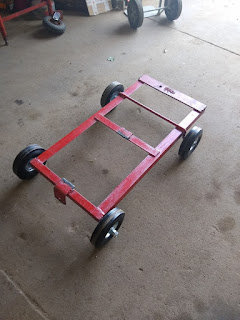
 I am now actively conducting thrust tests on the PIE 4.3 with positive results.  Since it certainly appears to have a lot of propulsive force in bench tests and is rather unruly on the bench, it seems that a heavy and sturdy cart should be used.  I have modified a steel cart, which I had originally built for an entirely different purpose, just to be the new PIE 4.3’s cart complete with solid solid tires and ball bearing wheels.   New Cart With New Wheels It took several runs at nearly full speed to properly adjust the sun gear for forward thrust without pulling to one side or the other. During those test runs, there was enough force to move the cart forward and slide the wheels sideways approximately 10 inches.   Mounting The PIE 4.3 To The New Cart During those test runs, one outer stop broke and the excessive lash on one of the planet gears caused it to skip timing, but even though weaknesses were obvious the overall test was successful. PIE 4.3 On Its Wh...

PIETECH Volume 1, page 1: PIE 4.0 and PIE 2.0 Thrust Stall Test Results

Image
      PIETECH As we open a new chapter in the PIE project previous chapters are not closed, instead they continue as the earliest pioneering efforts put forth leading to PIETECH and will undergo more extensive power in/out ratio testing for scientific purposes. The PIE 1.0 & 2.0 are also the necessary “trainers” to teach the concepts of PIETECH, and actual building plans are forthcoming within the next few months! Update added: The PIE 2.0 requires just over 30 oz of thrust to self-propel as seen in the earlier posted video. Another test was run, using weights placed in front of the PIE 2.0. The weights were added until it would not move them, then backed off until movement was just apparent. Then a digital scale was used to push the whole rig forward in order to determine maximum thrust (stall method). This test was repeated a total of 8 times with identical results. Maximum thrust is now calculated at 230 oz which is 14.375 lbs or 6.52 kg. Bryan- PIE 3.0 i...

Volume 2 Page 15, PIE 4.0, The High Speed PIE:

Image
PIE 4.0 The latest incarnation of the PIE is kind of a step back to an earlier design as well as a step forward to push the limits of PIETECH possibilities.   I am using a single wheel (for now) with a much lighter weight, even lighter than the PIE 1.0 design. I am trying out a quiet gear set which uses a 14mm pitch timing belt as the teeth which is fastened to the same size (3.5") steel pulley as used on the PIE 1.0 & 2.0, and although it is quieter I am not sure if the teeth are robust enough to use as a spur gear. Initial testing of the PIE 4.0 is very encouraging, although there are some small issues arising from the increased speed which has currently been measured at just over 750 RPMs. The most serious issue has been the used motor I pulled off of the storage shelf. Although the 110 volt motor was marked as “Good” because it runs well without a load, it quickly overheats and shuts down when it is turning the PIE4.0. The other issue is the soft gear design which seem...

Comments about Comments, and Thank You

I have received a number of comments on YouTube, Bit Chute and by other means regarding the inefficiency of this design, and how other designs are soooo much more efficient and can produce these vast amounts of thrust, how this will never work and I am wasting my time chasing this dream. I have been pointed towards many fine inventor's works and have had private message conversations with some about some of these. Here is the deal: 1- I am going to pursue this to some sort of conclusion, it will either be successful or not.  2- There are those who want this stopped. 3- There are others who think there is a better way but have not built a prototype. 4- There are those who don't give a crap but like to make fun of other's efforts. 5- There is always "self doubt" when trudging through the swamp of the unknown. 6- Do not try to force your opinions on me and I will not try to force mine on you. 6- Tell me it can't be done and watch me go, but do not get in the way....

New Announcements, Global Collaboration, and "PIETECH Electric Propulsion":

  Announcement: Announcing "PIETECH Electric Propulsion": It has been a couple of weeks since my last post, but I do not want anyone to think I am not actively pursuing this quest for universal electric propulsion. The Grassroots Mechanic Movement continues the "Open Source" mission to see this technology advance and freely share information. The Grassroots Mechanic Movement is also in a well controlled growth period which will be branching out creating a somewhat separate entity which will be the "industrial development" branch known as "PIETECH Electric Propulsion" which still needs a logo. Everything here on  The Grassroots Mechanic Movement blog remains free and Open Source always, but PIETECH Electric Propulsion is going to allow the PIE technology to expand into the industrial mainstream as this still-infant technology grows and matures. Current Work: Currently I am continuing the R&D work necessary to advance the technology of the...

Volume 2, Page 14, Re-Phasing the PIE 2.0 and Ground-Test #2 - SUCCESS!!!:

Image
Re-phasing for Performance Since the PIE 2.0 did not perform as well as expected on the “self-propulsion” portion of testing, it was removed from the pallet for rework on the work bench. The phasing of the upper and lower wheels is the primary area to be reworked as the possible answer to its poor performance. The PIE 2.0 was not built for easy phase adjustments, so the rework included the removal of all planet gears and axles. The rework is a re-phase of the wheels from a 90-degree offset to a 0-degree offset. It would be much better to change the phase offset in smaller increments (say 10, 20 or even 40) but since this is the way already built into the design, this is how it is being done. Fast Forward a Couple of Days Later and “Ground Test #2”… That has done it! The re-phasing has made significant improvements in the quest for “self-propulsion”! It will now work its way across the garage floor under its own power with nothing driving the wheels! The upper planet gears and...

Vol 2, Page 13, Ground Testing

Image
  Post vehicle, wheeled, ground-testing. After a short pause caused by things in life that have required my undivided attention, I’m back & ready to get busy.   So, the on-road testing would be considered a success, and the “hybrid-assist” effect is undeniable. The “failures” encountered within that round of testing were due to the prototype building methods and materials. It is hard to justify the cost in time and materials for a more durable build when it is being taken apart and changed multiple times. Total cost of materials for a single planet gear, without the weight, is around $8 US. The cost of a machined, straight toothed, drilled hole center, spur gear of the same size is around $200 to $300 US. In that light, the component failures are an acceptable offset to the cost differential. Now we move forward with further testing of the PIE 2.0 while still getting ready to build a next version.  **************************************************************...

Vol 2, Page 12, Successful Testing and Prototype Component Failures

Image
PIE 2.0 All Pretty -- Before Being Worked Hard, Out in the Real World  I find that it has been tough to get busy and simply do what needs to be done lately. The PIE 2.0 has had to take a “back seat” to far more important family business, but I finally did get some time to finish up some “real world” testing at a reasonable speed of 55 MPH (88 KPH). It is not an easy thing to find a “flat” stretch of highway in the Northeastern United States (about 350 miles inland), so I have made do with a straight stretch with only some small rolling hills and with an estimated elevation rise from start to finish of approximately 15-20 feet (not verified with altimeter). As before, measurements are taken and only considered valid if measured values are repetitively similar. I was able to bring the PIE 2.0 up to slightly over 120 RPMs and test before it broke this last time and left a weight laying in the truck bed. So, here is a simplified recap of test results obtained on this test roadw...

Vol 2, Page 11 - Getting Back To Work & Another Approach to Planetary Gears -FAILURE UPDATE AT END OF POST-

Image
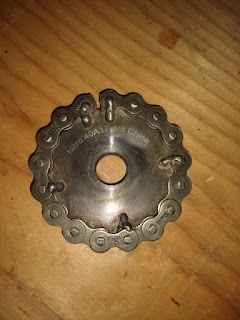
Next Gen Test Gear After some unexpected personal business (death in the family) to be attended to, I am excited to pick up where I left off with the PIE 2.0. I had to remove the test rig from the test vehicle in order to transport several loads of “rubbish” from a deceased family member’s apartment to be delivered to either a charity donation center or a dumpster for disposal. The Pie 2.0 is fastened back into the test vehicle, testing routs are mapped out for highway speed testing, and I am ready to start recording data. As seen in the photo above, I have also been working on an improved method of obtaining and making planetary gears. The latest idea on this front is an inside-out chain drive/sprocket assembly. I don’t think that it is a long-term production solution, but it seems to present a reasonably inexpensive alternative to making gears from scratch. The nice people at www.RollerChain4less.com (Nitro Power Products, LLC) have 17-tooth idler sprockets wi...

Vol 2, Page 10, Preliminary Test Results

Image
The PIE 2.0 is running much better now, and although it was not without frustration, I was finally able to make some test runs. I did have to make some repairs to the lower sun gear and I also corrected the crooked outer stop. One of the teeth on the lower sun gear broke off and when that happened the lower wheel started "jumping timing" like crazy. When the failure(s) happened, the timing got pushed to the 11 o’clock position and that is a bit too “retarded” or “late”, the planetary alignment position (I like that terminology) should be a bit earlier at about 10 o’clock. This late timing is very evident in the PIE’s upper framework, when running at just over 100 RPMs the upper frame deflects to the right which tells me I am losing forward propulsion power. I am fortunate enough to be able to see the upper part of the pie in my rear view mirror while driving so I was able to visually see that the timing was off. I took a short video of the sideways movement to demonstrate...